
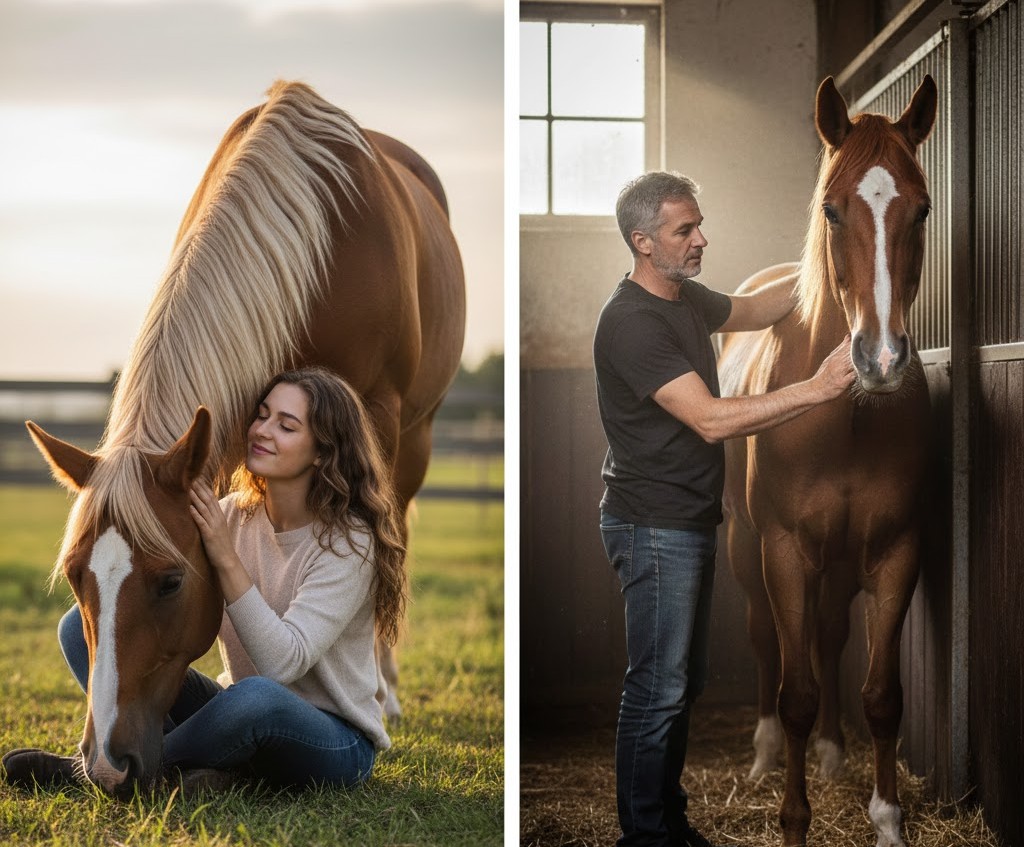
If you’ve ever felt like your horse “read your mind,” you’re not imagining things. Horses often react before a rider gives an obvious cue, and sometimes they react to a cue that the rider believes they never gave. This can be confusing at first—especially for people who are used to human communication, where words and explicit signals carry most of the meaning. With horses, the communication system runs deeper. Horses respond to the whole picture: your posture, balance, muscle tone, breathing, emotional state, and intention. In many cases, your “energy” speaks louder than your commands.
To unpack this, we need to define what riders typically mean by energy. In the equestrian world, energy isn’t a mystical force. It’s the combined expression of your body and nervous system: the way you carry yourself, how your muscles engage, where your attention goes, and the emotional tone you bring into the interaction. Horses are exquisitely sensitive to these variables because their survival depended on noticing subtle changes in the environment. A predator doesn’t always announce itself loudly. Often, danger is hinted at through a small shift—an unusual stillness, a tension in another animal, or a slight change in movement. Horses learned to notice what most humans overlook.
That sensitivity means your horse feels you long before it hears or sees a “command.” A rider who is anxious may grip with the knee, hold the breath, tighten the lower back, and shorten the reins without realizing it. The rider may think, “I’m just sitting here.” The horse experiences: pressure, restriction, and uncertainty. Then the rider asks for forward, and the horse hesitates or rushes. From the rider’s perspective, the horse is being difficult. From the horse’s perspective, the rider’s body already said, “Something is wrong.” The horse reacted to the energy first, not the cue second.
This is why contradictory signals are so common in riding. Humans can want one thing and communicate another. You might want your horse to canter, but if you’re afraid, your body might brace and block. You might want your horse to stand quietly, but if you’re impatient, you might fidget, shifting your weight and sending “move” signals. Horses don’t have the human ability to rationalize. They trust what they feel. If the body message and the verbal or mechanical cue conflict, the horse tends to believe the body.
Intention plays a major role as well. Many experienced riders can influence a horse simply by changing focus and posture. Think about walking behind someone in a narrow hallway. You don’t need words to communicate urgency; your speed and proximity communicate it. Horses feel that same kind of intention. When you prepare to turn, your inside hip rotates slightly, your weight shifts, your eyes and shoulders align with the new line. Even before you apply the rein or leg, the horse feels a change in balance and direction. The best riding often looks “invisible” because the cues happen at the level of intention and balance rather than force.
Horses also respond to the emotional tone of the situation. A handler who is calm and confident tends to move predictably, breathe steadily, and offer consistent contact. A handler who is frustrated tends to move abruptly, pull harder, and lose timing. Horses don’t interpret frustration as a motivational speech. They interpret it as instability or threat. This is why a tense training environment can create a tense horse. It’s not that the horse is “absorbing” emotions like a sponge in a mystical way. It’s that emotional states directly change human movement patterns, and horses are designed to notice movement patterns.
Another reason horses react early is that they are constantly making predictions. In the herd, prediction is safety. If one horse in the group lifts its head and tenses, others prepare to run. Horses learn patterns quickly: when the girth comes out, work is coming. When the rider shortens the reins, a transition is likely. When the rider sits taller and engages the core, collection or stopping might happen. If you repeatedly pair a particular posture with a command, the horse learns to anticipate. Anticipation can be helpful when it creates smooth communication, but it can become a problem if it leads to rushing, anxiety, or resistance. Understanding anticipation helps riders adjust: vary routines, reward calm responses, and practice transitions without tension.
So how do you make energy work for you rather than against you? The first step is regulation. Before you ask your horse to regulate its emotions, regulate your own. Take a slow breath. Check your shoulders, jaw, and hands. Let your seat feel heavy and your legs feel long. Focus your gaze where you want to go. Horses respond to clarity. When your body is organized, your aids become consistent and your horse can trust the request.
The second step is congruence. Make sure your body is supporting the message. If you want forward, your posture should be open and inviting, not braced. If you want stillness, your seat should be quiet and steady, not restless. Congruence reduces confusion and builds confidence in the horse.
The third step is timing. Horses learn from the release, not the pressure. If your energy escalates and stays elevated, the horse may become anxious. If your energy rises for the cue and then softens immediately when the horse responds, the horse learns the cue is safe and clear. Good timing turns energy into information rather than stress.
Finally, consider the environment. Horses react to everything around them, not just you. If a horse is already on edge—new arena, loud noise, unfamiliar horses—your energy matters even more. In those situations, calm leadership is not optional. Your horse is looking to you as a safety reference. A regulated rider can become the “steady point” in a chaotic environment, which often leads to better behavior than any correction would.
The deeper lesson is that horses teach us a truth that applies to human relationships too: communication begins before words. People also respond to tone, posture, and emotional presence. Working with horses sharpens your ability to notice these signals and to manage your own. The horse’s quick reaction is not a flaw. It’s a form of intelligence—and once you learn to speak that language, your riding becomes calmer, clearer, and more humane.