
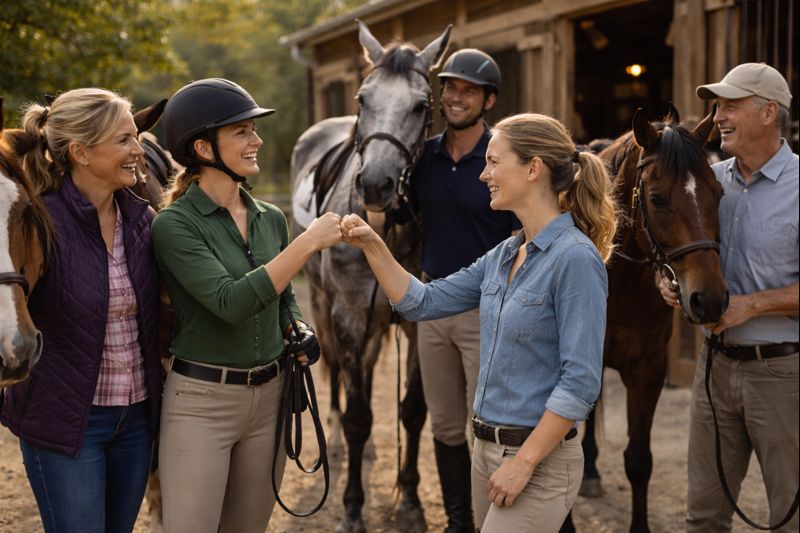
The equestrian world often appears solitary from the outside. Early mornings, individual training sessions, and hours spent caring for horses can create the impression that riding is a largely independent pursuit. While much of the work does happen one-on-one with the horse, no rider truly develops alone. Behind every successful partnership is a network of people who support, challenge, educate, and sustain both horse and rider.
Community in the equestrian world is not a social accessory. It is a structural element that shapes learning, safety, resilience, and long-term engagement in the sport.
Horsemanship Is Not Learned in Isolation
Working with horses involves complex skills that span training, health, behavior, and management. No single person can master all of these areas alone.
Communities provide access to shared knowledge:
- Experienced riders offer perspective and context
- Trainers guide technical development
- Grooms and barn staff contribute practical expertise
- Veterinarians and farriers support health and soundness
- Fellow riders share lived experience
Learning accelerates when knowledge is shared. Isolation slows progress and increases the likelihood of avoidable mistakes.
Informal Learning Happens Constantly
Some of the most valuable lessons in horsemanship are not taught in formal settings. They are learned through observation and conversation.
In barns and at events, riders absorb information by:
- Watching others handle similar challenges
- Listening to discussions about training and management
- Seeing how different horses respond to similar situations
- Learning what worked—and what did not—for others
This informal learning fills gaps that structured instruction may miss. Community creates a living classroom where education is continuous.
Emotional Support in a Demanding Sport
The equestrian world is emotionally demanding. Horses become injured. Training stalls. Confidence fluctuates. Financial and time commitments add pressure.
Community provides emotional grounding. Fellow riders understand frustrations that outsiders may dismiss or misunderstand. Sharing experiences reduces isolation and normalizes challenges.
Support does not always come as advice. Sometimes it is simply presence—someone who understands without explanation.
Safety Through Shared Awareness
Horses are powerful, unpredictable animals. Safety depends on awareness, communication, and preparedness.
Strong barn communities enhance safety by:
- Sharing information about horse behavior
- Offering assistance during handling
- Noticing changes in routine or demeanor
- Supporting emergency response
A culture where people watch out for one another reduces risk for both humans and horses.
Accountability That Encourages Growth
Community creates accountability without coercion. When riders train alongside others, standards emerge organically.
Positive accountability may include:
- Encouragement to maintain routines
- Gentle reminders to prioritize horse welfare
- Exposure to higher standards of care or riding
- Motivation to improve through example
This form of accountability supports growth without competition or judgment.
Shared Resources and Practical Support
Equestrian pursuits are resource-intensive. Community helps distribute knowledge and practical support.
Shared resources may include:
- Recommendations for professionals
- Equipment advice and fitting insights
- Shared transport or logistics
- Problem-solving around management challenges
This collaboration reduces trial-and-error and improves outcomes for horses.
Learning Through Diverse Perspectives
Every rider brings a different background, discipline, and philosophy. Community exposes individuals to multiple viewpoints.
This diversity:
- Encourages critical thinking
- Prevents rigid adherence to a single method
- Promotes adaptability
- Broadens understanding of horses as individuals
Exposure to differing approaches fosters thoughtful horsemanship rather than blind imitation.
The Role of Mentorship
Mentorship is one of the most powerful aspects of equestrian community. Experienced riders guide less experienced ones through challenges that cannot be learned from books.
Good mentors:
- Offer perspective rather than control
- Share mistakes as well as successes
- Encourage independence
- Prioritize horse welfare
Mentorship preserves institutional knowledge and strengthens the next generation of horsemen.
Community and Longevity in the Sport
Many riders leave the equestrian world not because of lack of passion, but because of burnout, isolation, or discouragement.
Community supports longevity by:
- Providing motivation during difficult phases
- Offering reassurance after setbacks
- Creating a sense of belonging
- Sharing the emotional load of care and responsibility
Riders who feel connected are more likely to stay engaged long-term.
Navigating Competition and Comparison
Community helps riders navigate competition in healthier ways. When relationships are built on respect rather than rivalry, comparison becomes informative rather than destructive.
Supportive communities encourage:
- Learning from others’ success
- Respecting individual journeys
- Celebrating progress beyond results
This environment fosters confidence and resilience.
Community Shapes Barn Culture
Every barn has a culture shaped by its people. Community norms influence how horses are treated, how mistakes are handled, and how success is defined.
Healthy barn cultures:
- Prioritize horse welfare
- Encourage respectful communication
- Support learning and curiosity
- Address issues constructively
Culture is sustained by community behavior, not rules alone.
Digital Communities and Modern Connection
Online communities now complement physical ones. Forums, social media groups, and educational platforms allow riders to connect across distance.
When used thoughtfully, digital communities:
- Expand access to information
- Provide diverse perspectives
- Reduce geographic isolation
However, digital spaces work best when grounded in respect and critical thinking.
Challenges Within Communities
Community is not without challenges. Differences in opinion, communication styles, and expectations can create conflict.
Healthy communities address challenges through:
- Open dialogue
- Clear boundaries
- Mutual respect
- Focus on shared values
Conflict handled constructively strengthens community rather than weakening it.
Horses Benefit From Human Community
Strong human communities benefit horses directly. Better-informed, supported riders make better decisions.
Horses in supportive environments often experience:
- More consistent care
- Earlier detection of issues
- More thoughtful training
- Reduced stress during handling
Community indirectly improves horse welfare.
Belonging as a Foundation for Growth
At its core, community offers belonging. Feeling seen and supported creates psychological safety.
Psychological safety allows riders to:
- Ask questions without fear
- Admit uncertainty
- Accept feedback
- Take appropriate risks in learning
Growth thrives where belonging exists.
Why Community Truly Matters
The equestrian journey is too complex, demanding, and meaningful to be traveled alone. Horses teach us connection through partnership. Community extends that lesson to human relationships.
Beyond training techniques and results, community sustains passion, protects welfare, and deepens understanding.
In the equestrian world, community is not optional. It is the thread that connects knowledge, care, resilience, and growth—holding the entire experience together.