
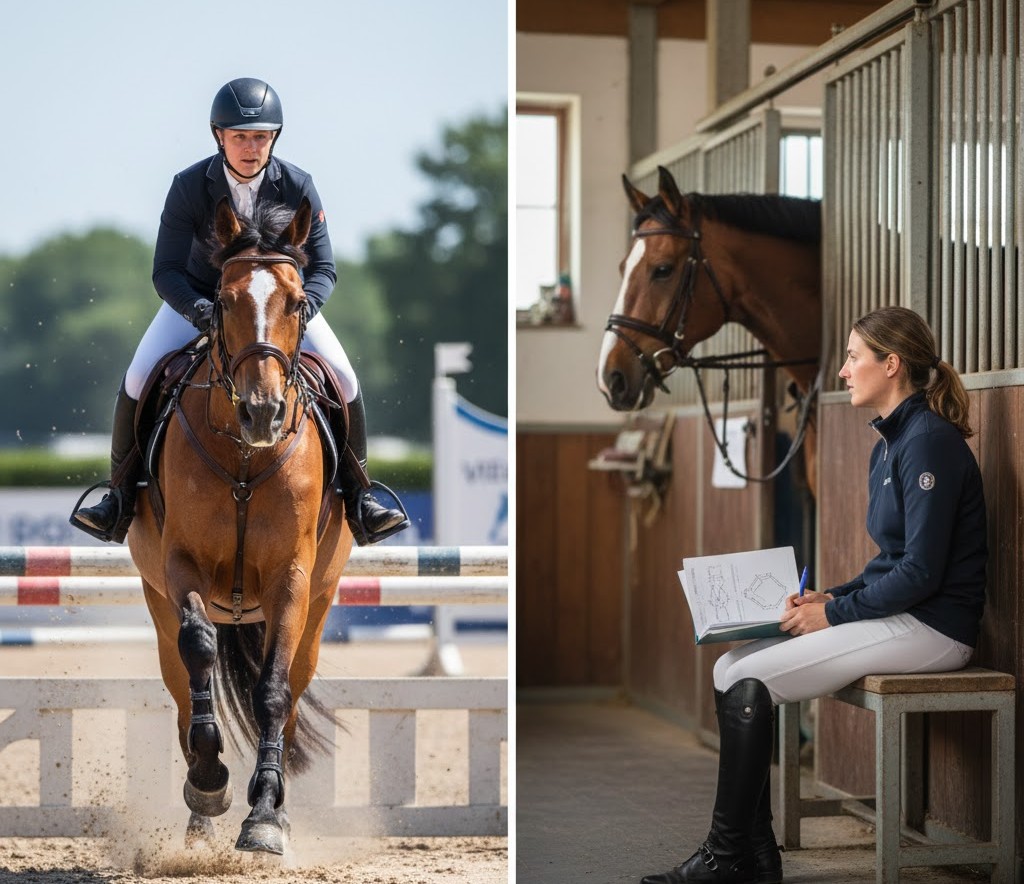
Emotional regulation is one of those skills everyone talks about, but few people truly practice in real time—especially under pressure. Horses, however, make emotional regulation unavoidable. They don’t respond to the story we tell ourselves, the explanation we give, or the image we want to project. They respond to what’s happening in our nervous system right now: breathing, muscle tone, focus, intention, and tension. For that reason, horses can become remarkably honest teachers of calm, clarity, and emotional maturity.
To understand why, it helps to remember what horses are. They are prey animals with a survival strategy built around reading the environment for danger. In the wild, noticing subtle cues—an unusual stillness, a shift in energy in the herd, a movement in the grass—can mean the difference between safety and becoming someone’s meal. That sensitivity did not disappear when horses became domesticated. It simply moved into the modern stable, where the “predator cues” might be our rushed footsteps, tight hands, impatient corrections, or anxious mental chatter. A horse is not being dramatic when it reacts to those signals. It is doing what it was designed to do: interpret threat and choose the safest response.
This is the first emotional lesson horses offer: presence matters more than performance. Many people enter the barn carrying the residue of the day—stress from work, frustration from traffic, worry about finances, or pressure to “get better” quickly. Humans are incredibly good at operating while emotionally split: body in one place, mind in another. Horses are not. They will often bring you back to the present with something as simple as refusing to stand quietly, stepping away during grooming, bracing against the bridle, or becoming inattentive under saddle. It’s not punishment. It’s feedback. The horse is telling you, “You’re here, but you’re not here.”
The second lesson is self-awareness. Emotional regulation starts with noticing what you feel before you act. With horses, self-awareness becomes practical, not philosophical. You learn to ask: Am I holding my breath? Are my shoulders creeping up? Is my jaw tight? Are my hands steady or gripping? Is my focus scattered? Horses are highly attuned to these micro-signals. A rider who is anxious often shortens the reins unconsciously, locks the elbows, and tightens the thighs. A horse then feels trapped, which may create tension, rushing, spooking, or resistance. From the rider’s perspective, it can feel like the horse “started it.” From the horse’s perspective, the horse is responding to an escalating pressure that began in the human body.
Breathing is the simplest gateway to regulation, and horses are excellent breathing coaches. When you exhale slowly, your ribcage softens, your pelvis becomes more mobile, and your aids become clearer. Many riders notice their horse relaxes the moment they breathe out and soften. That is not mystical—it’s biomechanics and nervous system communication. A regulated rider moves with more fluidity and gives more consistent signals, which the horse can understand and trust.
Horses also teach the difference between calm and shutdown. Some humans confuse emotional regulation with suppressing emotion. They “control themselves” by going numb. Horses rarely respond well to numbness. A disconnected rider can be as confusing as an angry one because the horse can’t read intention. Regulation isn’t about eliminating emotion. It’s about staying responsive and grounded. The goal is a calm, clear presence: you feel the emotion, you notice it, and you keep your actions thoughtful rather than reactive.
That leads to another lesson: emotions are information, not instructions. Fear can signal that your body doesn’t feel stable, your environment feels unsafe, or your horse is unpredictable today. Frustration can signal unclear communication, unrealistic expectations, or physical fatigue. But emotions don’t automatically deserve the steering wheel. Horses reward riders who can recognize emotion and still choose the next right step: take a walk break, do a simpler exercise, return to basics, or end on a calm note.
Because horses are large and powerful, they also teach boundaries and respectful leadership. Emotional regulation is not only about being “nice.” It’s about being consistent and fair. Horses feel safer with humans who provide clear structure. A regulated handler can say “no” without anger, can correct without humiliation, and can insist on respectful behavior without escalating into a fight. This is a surprisingly transferable life skill: the ability to hold firm boundaries while staying calm and kind.
Horses also show how quickly stress can be released. Watch a horse startle at a loud noise. The body tenses, the head lifts, the eyes widen. Then, if nothing else happens, the horse often returns to neutral within minutes—grazing, licking and chewing, or dropping the neck. Humans often do the opposite: we startle, then replay the event for hours. Working with horses encourages a healthier cycle: acknowledge the stress response, then return to baseline when safety is restored. Riders learn to take one deep breath, soften, and continue rather than spiraling.
Training sessions are a laboratory for emotional flexibility. Some days, your horse feels forward and soft. Other days, the same horse feels stiff, distracted, or reactive. Emotional regulation means adapting without taking it personally. A rider who insists that today must look like yesterday often becomes rigid and frustrated. The regulated rider asks different questions: What does my horse need today? More warm-up? Less intensity? A different environment? This shift from ego-driven riding to horse-centered riding is one of the most mature forms of regulation.
Over time, horses help people develop a deeper emotional vocabulary. Instead of labeling everything as “stress,” riders learn nuance: anticipation, overstimulation, uncertainty, fatigue, frustration, confusion, curiosity. When you can name an emotion accurately, you can manage it more effectively. That is emotional intelligence in action, and horses invite it through repeated, real-world practice.
Finally, horses teach accountability without shame. If your horse is tense, you can ask what you contributed—without collapsing into guilt. If you rode impatiently, you can apologize through better choices: a softer hand, a slower progression, a more generous break. Regulation grows when you accept feedback, adjust, and continue.
In everyday life, the benefits show up quietly. Riders report they pause before responding in conflict, breathe more consciously, and recognize rising stress earlier. They learn that calm is not weakness and boundaries are not cruelty. Horses don’t teach emotional regulation through theory. They teach it through experience—one breath, one choice, one moment of presence at a time.