
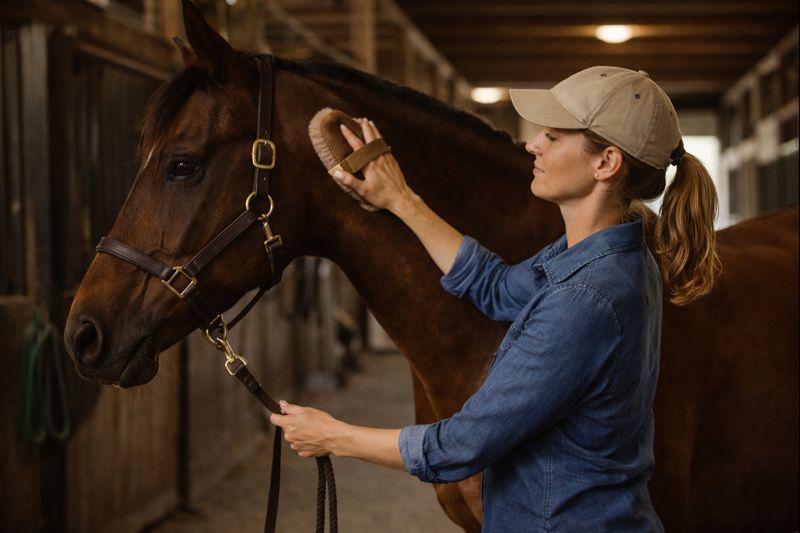
The stable is often seen as a place separate from “real life.” It is where people go to ride, train, compete, or escape daily responsibilities. Yet for many riders, the lessons learned around horses quietly shape how they think, react, and relate to the world far beyond the barn. These lessons are rarely taught explicitly. They emerge through routine, responsibility, and repeated interaction with an animal that responds honestly to behavior rather than intention.
What makes the stable such a powerful learning environment is that it strips situations down to fundamentals: clarity, consistency, patience, and accountability. Horses do not respond to excuses or good intentions. They respond to what actually happens. That reality offers lessons that translate surprisingly well into everyday life.
Responsibility Without External Validation
Caring for a horse teaches responsibility in its most grounded form. Horses need food, water, movement, and care regardless of mood, schedule, or motivation. There is no audience applauding daily turnout or properly cleaned tack. The reward is simply that the horse remains healthy and willing.
This kind of responsibility builds internal accountability. Tasks are done because they matter, not because someone is watching. Over time, this shapes a mindset where reliability becomes part of identity rather than something performed for recognition.
In everyday life, this often translates into stronger work ethic, follow-through, and consistency—especially in tasks that are unglamorous but essential.
Patience as a Practical Skill
Few environments teach patience as directly as the stable. Horses do not rush because humans are busy. Progress happens at the horse’s pace, not the rider’s timeline.
Training a horse involves repetition, incremental improvement, and setbacks. One day may feel productive; the next may feel like starting over. Riders quickly learn that forcing progress usually creates resistance rather than results.
This teaches a crucial life lesson: patience is not passive waiting. It is active persistence without emotional escalation. In daily life, this skill appears as the ability to tolerate slow progress, remain calm during delays, and continue working without frustration dominating behavior.
Clarity Over Emotion
Horses respond to clarity, not intensity. Strong emotions—anger, anxiety, excitement—often confuse rather than motivate them. Clear signals, delivered calmly and consistently, are far more effective.
This teaches an important communication principle: being louder or more emotional does not make a message clearer. In fact, it often makes it harder to understand.
Many riders notice that over time they become more concise and intentional in how they communicate with people. They learn to pause, simplify, and deliver messages without unnecessary emotional charge.
Consistency Builds Trust
Trust with horses is built through predictable behavior. When cues mean the same thing every time, horses relax. When expectations shift randomly, they become tense or resistant.
Consistency in the stable is not rigid repetition. It is reliability. The horse learns what to expect and how to succeed.
This lesson applies directly to relationships, leadership, and teamwork. People, like horses, feel safer when expectations are clear and behavior is stable. Inconsistency erodes trust faster than mistakes.
Immediate Feedback Without Judgment
Horses provide immediate feedback, but they do not assign moral value to mistakes. If a cue is unclear, the horse responds accordingly. There is no resentment, no grudge, no interpretation.
This creates an environment where mistakes are part of learning rather than sources of shame. Riders learn to adjust rather than defend themselves.
In everyday life, this fosters resilience. Instead of reacting defensively to feedback, experienced riders are more likely to ask, “What can I change?” rather than “Why did this happen to me?”
Emotional Regulation Through Consequence
In the stable, emotional regulation is not optional. Losing patience, becoming distracted, or reacting impulsively has immediate consequences in safety and effectiveness.
Riders learn to manage their emotions not because it is virtuous, but because it works. Calmness produces cooperation. Reactivity produces tension.
This experiential learning often carries into stressful situations outside the barn. Riders may notice they handle conflict more steadily, recover from frustration faster, and recognize emotional escalation earlier.
Respecting Limits—Yours and Others’
Horses have physical and mental limits. Ignoring them leads to resistance, injury, or loss of trust. Good horsemen learn to recognize when to push and when to stop.
This develops an appreciation for boundaries. Not every day is a training day. Not every problem is solved by more effort.
In daily life, this translates into healthier work habits, improved self-awareness, and greater respect for others’ capacities. Learning to stop before burnout is a skill many people struggle to acquire elsewhere.
Presence Over Multitasking
Multitasking does not work around horses. Inattention leads to mistakes. Presence keeps everyone safe.
Stable tasks—leading, grooming, riding—require awareness of space, movement, and timing. The mind must be where the body is.
This trains focus. Riders often report improved concentration and reduced mental noise outside the barn. Presence becomes a practiced habit rather than an abstract concept.
Progress Is Not Linear
Horses make progress in waves. Improvement often comes after periods that feel stagnant. Setbacks occur without obvious cause.
Learning to accept non-linear progress without discouragement is one of the most transferable lessons from the stable. Riders learn that consistency matters more than constant success.
This mindset is valuable in education, careers, relationships, and personal growth—areas where progress rarely follows a straight line.
Accountability Without Blame
When something goes wrong with a horse, blaming the horse rarely solves the problem. Effective riders look inward: timing, clarity, preparation, environment.
This fosters accountability without self-punishment. Responsibility is assumed, but mistakes are treated as information rather than failures.
In everyday life, this approach supports growth. Problems become opportunities for adjustment instead of sources of shame or conflict.
Humility as a Strength
Horses regularly remind humans that control is limited. Even experienced riders encounter moments where the horse teaches rather than obeys.
This builds humility—not as insecurity, but as openness to learning. No one ever “finishes” learning how to work with horses.
In professional and personal contexts, this humility often appears as adaptability, willingness to seek feedback, and respect for experience over ego.
The Stable as a Training Ground for Life
The stable is not a classroom, yet it teaches continuously. The lessons are not delivered in words, but in outcomes. What works stays. What does not, fails quickly.
These lessons shape how riders approach challenges, relationships, and responsibilities. They encourage patience over urgency, clarity over emotion, consistency over intensity.
Carrying the Lessons Beyond the Barn
Many riders do not realize how deeply the stable has influenced them until they step into other environments. They notice they handle stress differently, communicate more clearly, and remain steadier under pressure.
The horse does not teach these lessons intentionally. They emerge naturally through honest interaction.
In this way, the stable becomes more than a place to ride. It becomes a quiet training ground for everyday life—one where effort, awareness, and responsibility are refined through experience rather than instruction.
The lessons learned there are not left at the gate. They walk out with the rider, shaping how life is approached long after the horse is untacked.