
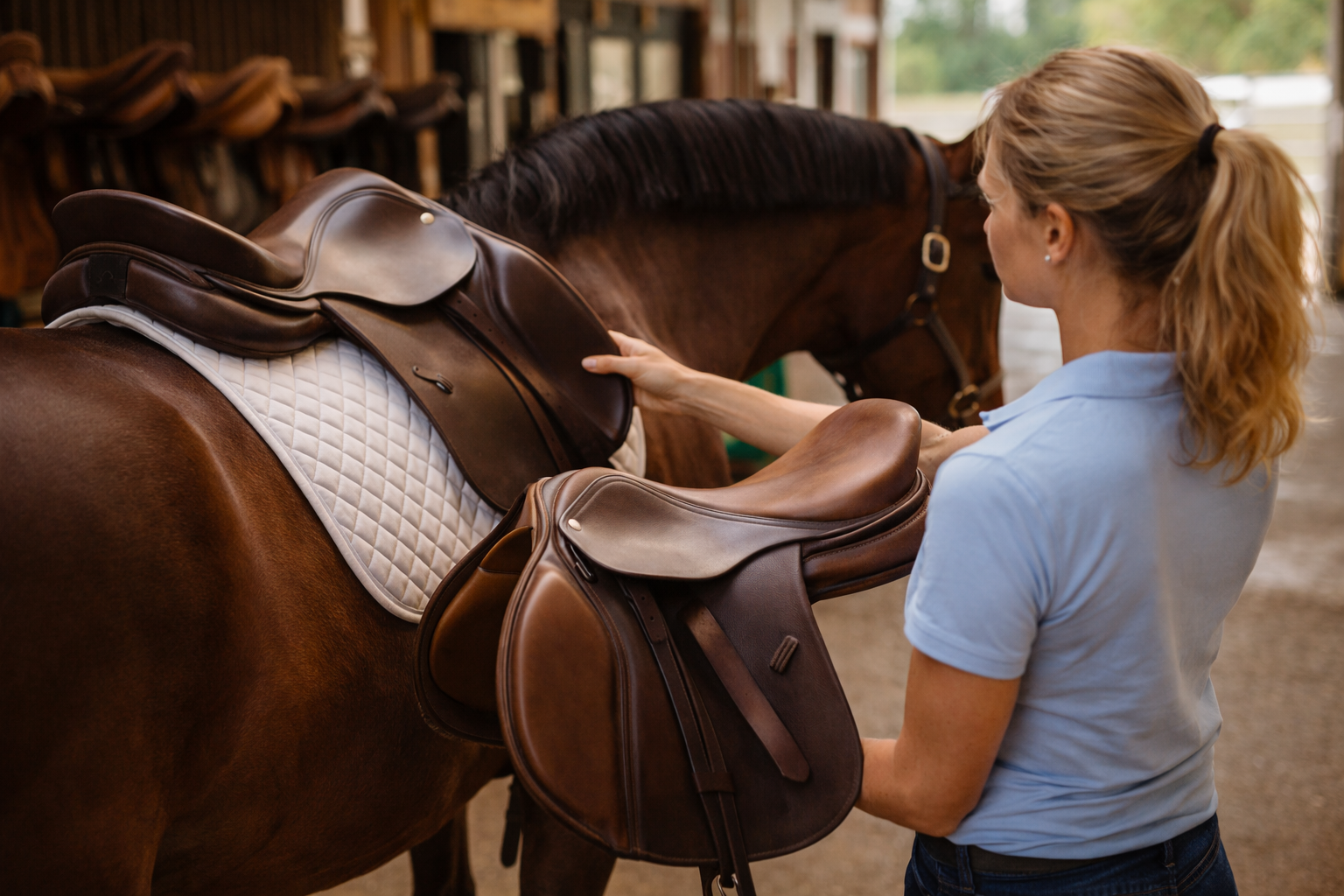
Choosing a saddle is one of the most important decisions a rider makes, yet it is often treated like a shopping problem instead of a welfare issue. A saddle is not simply a seat; it is a load-bearing structure that affects how a horse moves, how a rider balances, and how clearly communication travels between them. When the saddle fits well, training can progress with less friction. When it doesn’t, even the best training plan becomes an uphill battle.
Saddle Fit Is About Comfort, Biomechanics, and Trust
Horses may tolerate discomfort quietly for a long time. That’s part of what makes saddle fit tricky. A horse might not show obvious lameness, yet still move with restriction, brace through the back, or develop resistance under saddle. Riders can misinterpret these signs as training problems when the horse is simply trying to protect itself.
A good saddle supports:
– Freedom of shoulder movement
– Ability to lift through the back
– Even weight distribution
– Stable rider position without forcing posture
Start With the Horse’s Shape—Not the Brand
Every horse has a unique back. Wither height, shoulder angle, rib shape, topline development, and overall symmetry all influence fit. A saddle that fits a high-wither Thoroughbred may be completely wrong for a wide-barreled cob, even if both are the same “size.”
Key conformation considerations include:
– **Withers:** high, moderate, or mutton-withered shapes need different tree clearance and panel contact
– **Shoulders:** a freer shoulder requires a saddle that doesn’t block rotation
– **Back length:** short-backed horses need a shorter panel bearing surface
– **Topline condition:** muscle development changes fit over time, especially in young horses or horses returning from time off
Understanding Tree, Panels, and Gullet Clearance
The tree is the frame of the saddle. The panels are the surfaces that contact the horse. The gullet is the channel that clears the spine.
A functional fit requires:
– Clearance over the withers (not only when standing, but also with the rider’s weight)
– Even contact through the panels, avoiding “bridging” (pressure at front and back with a gap in the middle)
– A gullet wide enough to clear the spine and allow back movement
– No pinching at the front, where many saddles restrict the trapezius muscle
Static Fit vs. Dynamic Fit: Why “Looks Fine” Isn’t Enough
Saddles must be evaluated in motion. A horse’s back lifts, rotates, and flexes during work. A saddle that appears stable while standing can shift, bounce, or pinch once the horse moves.
Dynamic signs of poor fit include:
– The saddle sliding forward onto the shoulder
– The saddle rocking front-to-back
– The rider being tipped into a “chair seat” or pitched forward
– Uneven sweat marks (dry spots can indicate pressure points)
– Behavioral changes as work intensifies (tail swishing, head tossing, bucking, refusing)
– A horse that struggles to stretch or maintain rhythm
Whenever possible, assess fit while the horse is moving at walk, trot, and canter—with the rider in the saddle.
Rider Fit: The Saddle Must Support Your Alignment
Even if a saddle fits the horse, it may not fit the rider. A rider fighting the saddle will create uneven pressure and inconsistent aids.
Consider:
– **Seat size and depth:** too small limits movement; too large reduces stability
– **Twist width:** affects hip comfort and leg position
– **Flap length and angle:** should match the rider’s femur length and discipline
– **Balance point:** the saddle should allow the rider to sit in the middle—not pushed back or tipped forward
A saddle that forces the rider out of balance often results in heavier hands, gripping legs, and an unstable seat—signals the horse feels immediately.
Discipline Matters, But Comfort Comes First
Different disciplines require different saddle designs. Jumping saddles support shorter stirrups and forward balance. Dressage saddles encourage a longer leg and deeper seat. Trail and endurance saddles prioritize long-term comfort and weight distribution.
But discipline is secondary to fit. A perfectly “correct” dressage saddle that pinches a horse will do more harm than a slightly less specialized saddle that fits well.
Adjustability: Helpful, Not Magical
Adjustable gullets and flocking can extend a saddle’s usability, especially for horses whose bodies change with training. However, adjustability does not fix a fundamentally wrong tree shape. Think of adjustability as fine-tuning, not a rescue plan.
When to Reassess Saddle Fit
Saddle fit should be checked regularly, especially when:
– Your horse gains or loses muscle
– Workload increases significantly
– You change disciplines or training goals
– The horse develops new behaviors under saddle
– You notice changes in topline, stride quality, or willingness
Even seasonal changes in weight and coat can subtly affect how a saddle sits.
A Practical At-Home Fit Check
You can’t replace a qualified saddle fitter with a quick checklist, but you can spot red flags. Before you ride, run your hand under the panels and feel for obvious tight spots. Check that the saddle isn’t sitting on the shoulder. Once you’ve ridden, look for even sweat patterns and watch how the saddle sits when the horse is relaxed afterward.
If you notice repeated asymmetry—one dry spot, one side slipping, one direction that always feels harder—treat that as meaningful data, not a coincidence.
The True Goal: Comfort That Improves Communication
A good saddle doesn’t just prevent pain—it improves the entire conversation between horse and rider. Horses move more freely when they can lift their backs and use their shoulders. Riders sit more quietly when the saddle supports balance. The result is softer contact, clearer aids, and a partnership that feels easier rather than forced.
When you choose a saddle with the horse’s comfort and the rider’s alignment equally in mind, you’re not just buying equipment. You’re investing in soundness, training progress, and trust.
Working With a Saddle Fitter Without Losing Your Own Judgment
A good fitter is a partner, but you are the constant in your horse’s life. Ask questions and learn the “why” behind recommendations. Take notes on how your horse moves in different saddles, and don’t ignore your own feel in the tack. The best fit is the one that supports soundness and improves movement over time, not just the one that looks tidy on a rack.