
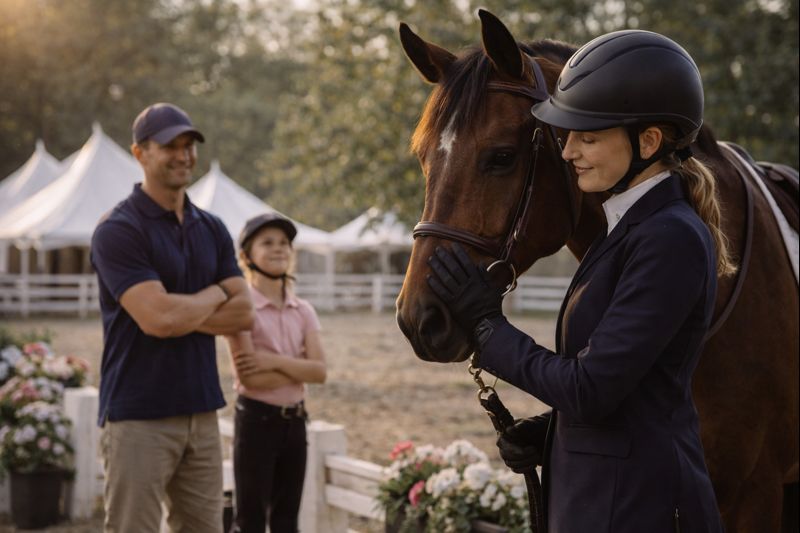
Equestrian events are often viewed through a narrow lens: scores, placings, ribbons, and rankings. For those outside the horse world—or even for riders early in their journey—events can appear to be purely competitive environments where success is measured only by results. Yet for many experienced riders, the true value of equestrian events lies far beyond the scoreboard.
Competitions, clinics, shows, and gatherings serve as learning environments, social hubs, and moments of reflection. They reveal strengths and weaknesses, foster community, and shape long-term development in ways that are not always visible in final standings.
Events as Learning Environments
Every equestrian event is an intensive learning experience. Riders encounter unfamiliar arenas, new footing, different horses, varied judges, and unexpected conditions. These variables test preparation, adaptability, and decision-making.
Unlike controlled home environments, events expose riders to real-world unpredictability. This exposure accelerates learning by revealing gaps that may remain hidden during regular training.
Even when performances fall short of expectations, the information gained is valuable. Riders learn how their horse reacts under pressure, how their preparation holds up, and which elements need refinement.
Feedback That Goes Beyond Scores
Scores and placings offer limited feedback. They summarize a moment but rarely explain it fully. The deeper feedback of events comes from observation and reflection.
Riders notice:
- How their horse warms up in a busy environment
- How quickly focus is regained after distractions
- Whether tension appears early or late in the day
- How fatigue influences performance
- How routines hold up away from home
These observations guide future training far more effectively than a number on a scoreboard.
Building Mental Resilience
Events challenge riders mentally as much as physically. Managing nerves, expectations, and pressure requires emotional regulation.
Riders learn to:
- Perform despite anxiety
- Accept imperfection publicly
- Recover after mistakes
- Stay focused amid chaos
- Separate identity from results
This mental training often becomes one of the most enduring benefits of participation. Riders who regularly attend events tend to develop stronger coping strategies, not just in sport but in life.
Exposure for the Horse
For horses, events are educational experiences. Traveling, stabling away from home, working in new environments, and encountering unfamiliar stimuli all contribute to mental development.
Even horses not destined for high-level competition benefit from controlled exposure. Experiences build confidence, adaptability, and emotional resilience.
Handled thoughtfully, events become part of a horse’s education rather than a test of tolerance.
Community and Shared Experience
Equestrian events bring together people who understand the realities of horse care, training challenges, and emotional investment. This shared context creates meaningful connection.
Conversations at events often go beyond competition:
- Discussing training approaches
- Sharing management strategies
- Learning from others’ experiences
- Offering support after difficult rounds
These interactions reduce isolation, especially in a sport that can be logistically and emotionally demanding.
Perspective Through Comparison—Without Competition
Watching other riders offers perspective that is difficult to gain alone. Riders observe different styles, techniques, and approaches.
Healthy observation is not about comparison for validation, but comparison for understanding. Seeing multiple solutions to the same challenge expands a rider’s toolkit.
Events remind riders that there is rarely a single “right” way—only methods that suit specific horses, riders, and goals.
Accountability and Motivation
Preparing for an event creates structure. Deadlines encourage consistency, planning, and follow-through.
Riders are more likely to:
- Maintain conditioning schedules
- Address weaknesses proactively
- Stay engaged during challenging phases
- Reflect on progress over time
This accountability supports discipline without requiring constant external pressure.
Testing Preparation, Not Perfection
Events test preparation, not perfection. They reveal whether training has been generalized beyond the home arena.
A movement that feels solid at home may feel different under pressure. An easy course may become challenging with unfamiliar footing. These discrepancies are valuable indicators, not failures.
Understanding this distinction helps riders approach events as diagnostic tools rather than judgment days.
Developing Sportsmanship and Humility
Equestrian events teach sportsmanship in subtle ways. Riders learn to celebrate others’ success, accept their own setbacks, and interact respectfully with officials and peers.
Humility emerges naturally when working with horses. Even the most prepared rider can have an unpredictable day. Learning to respond with grace builds character.
Clarifying Goals and Direction
Events often prompt reassessment. After participating, riders may adjust goals based on experience.
Some realize they enjoy the challenge and atmosphere. Others discover they prefer quieter training environments. Both outcomes are valid.
Events help riders define what success means personally, rather than accepting external definitions.
Creating Meaningful Memories
Not all memorable moments involve ribbons. Many riders recall:
- A calm warm-up after months of tension
- A horse loading quietly for the first time
- A successful recovery after a mistake
- Support from fellow competitors
These moments reinforce progress and commitment, even when results are modest.
Supporting Long-Term Development
Viewed over time, events contribute to a rider’s development arc. They provide milestones, reference points, and learning cycles.
Participation teaches riders how to prepare, reflect, and adapt. This cycle strengthens horsemanship more effectively than isolated training.
When Events Are Used Thoughtfully
The value of events depends on intention. When approached as learning opportunities rather than verdicts, they enrich both horse and rider.
This requires:
- Realistic expectations
- Attention to horse welfare
- Willingness to reflect honestly
- Respect for individual limits
When these principles guide participation, events become supportive rather than stressful.
Beyond the Arena
The lessons learned at events extend beyond riding. Riders develop confidence, resilience, communication skills, and emotional regulation that apply elsewhere.
Handling pressure, accepting feedback, and adapting under uncertainty are life skills reinforced through participation.
Redefining Value in Equestrian Events
When success is defined only by results, events feel narrow and unforgiving. When value is measured by growth, connection, and learning, events become enriching experiences.
The true worth of equestrian events lies not in winning, but in what riders and horses become through participation.
Beyond competition, events are classrooms, communities, and mirrors—reflecting both progress made and possibilities ahead.