
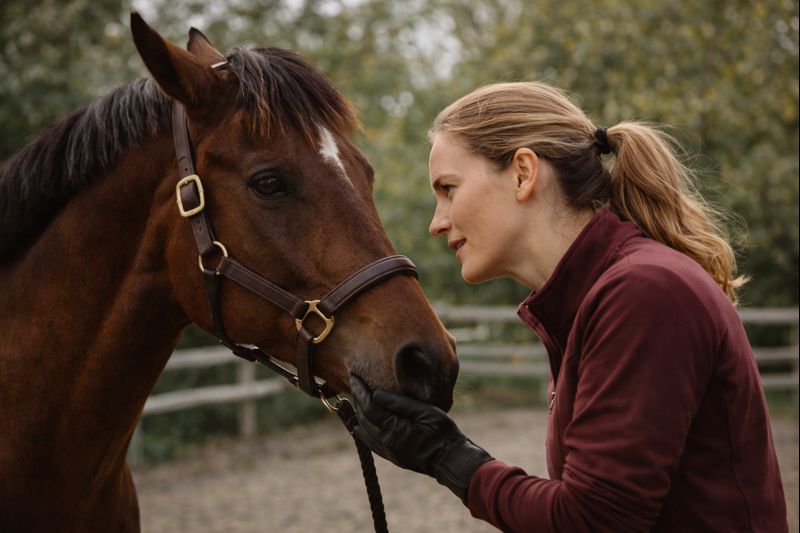
Communication is often understood as something we do with words. We speak, explain, persuade, clarify, and negotiate. Yet some of the most effective communication happens without language at all. Horses operate almost entirely in this non-verbal space, and that is precisely why working with them reshapes how humans communicate—not only in the saddle, but in everyday life.
Horses respond to timing, consistency, intention, and clarity. They do not interpret explanations or accept excuses. They react to what is actually presented. This dynamic turns every interaction with a horse into a lesson in communication fundamentals.
Communication Begins With Self-Awareness
Before a rider can communicate clearly with a horse, they must become aware of their own body. Horses notice posture, muscle tension, breathing patterns, and balance instantly. A rider who is unaware of these elements often sends conflicting signals.
For example, asking a horse to move forward while holding tension in the reins creates mixed information. The horse is not being disobedient—it is receiving contradictory input.
Through repeated interactions, riders learn that communication starts internally. Clarity with the horse requires clarity within the rider. This awareness often transfers to human interactions, where mixed signals are equally confusing.
Timing Matters More Than Intensity
Horses are exquisitely sensitive to timing. A light aid given at the correct moment is far more effective than a strong aid delivered late. This teaches an essential communication lesson: when something is said often matters more than how forcefully it is said.
In conversation, poorly timed feedback—even when accurate—can cause resistance. Well-timed communication, delivered calmly, tends to be received more openly.
Riders trained by horses often become more attentive listeners, noticing pauses, rhythms, and moments when communication is most likely to succeed.
Clarity Reduces the Need for Repetition
When communication with a horse is unclear, repetition increases. Riders may repeat cues, escalate pressure, or become frustrated. When communication becomes clear, repetition decreases dramatically.
Horses show riders that clarity simplifies interaction. One consistent signal produces understanding. Multiple conflicting signals create confusion.
This lesson applies directly to leadership, teaching, and teamwork. Clear expectations reduce the need for constant correction. Horses make this principle visible and unavoidable.
The Power of Consistency
Horses learn through consistent patterns. When a cue means the same thing every time, the horse relaxes and responds more confidently. When cues change unpredictably, the horse becomes tense or hesitant.
This reinforces a key communication principle: consistency builds trust. Inconsistent messaging—even when well-intentioned—creates insecurity.
Riders who internalize this lesson often become more reliable communicators in daily life. They follow through on commitments, align actions with words, and maintain steady expectations.
Learning to Listen Without Words
Communication with horses is a two-way process. While riders give cues, horses constantly respond through movement, posture, expression, and energy. Effective riders learn to read these responses.
Listening to a horse involves noticing:
- Changes in rhythm or tempo
- Muscle tension or relaxation
- Ear position and focus
- Willingness to move forward or slow down
- Subtle resistance or hesitation
This practice strengthens non-verbal listening skills. Riders become more observant and less reactive, skills that translate directly into human communication.
Reducing Emotional Noise
Strong emotions interfere with clarity. Horses respond poorly to anger, anxiety, or impatience because these emotions create inconsistent signals. Riders quickly learn that emotional regulation is essential for effective communication.
This teaches an important lesson: emotional control is not suppression, but regulation. Calmer communication produces clearer results.
In everyday life, this skill supports conflict resolution, leadership, and collaboration. Riders often become more measured in their responses, recognizing when emotion is distorting the message.
Simplicity Improves Understanding
Horses do not process complex explanations. They respond best to simple, consistent cues. Riders learn to strip communication down to essentials.
This encourages simplicity. Instead of adding more signals, riders learn to refine fewer ones. Instead of escalating pressure, they clarify intention.
This habit often carries into verbal communication. Riders may become more concise, focused, and intentional in how they speak, reducing unnecessary complexity.
Immediate Feedback Encourages Adjustment
Horses provide immediate feedback. If communication is unclear, the response shows it instantly. There is no delay, no rationalization, no social cushioning.
This creates a rapid feedback loop that encourages adjustment rather than defensiveness. Riders learn to change their approach instead of blaming the listener.
Over time, this builds adaptability—an essential communication skill in dynamic environments.
Body Language as Primary Language
With horses, body language is the primary language. Subtle shifts in weight, leg position, or breathing communicate more than force ever could.
Riders become more conscious of how they occupy space and how their bodies influence others. This awareness enhances presence and confidence.
In human interactions, this translates into better posture, clearer non-verbal signals, and stronger alignment between words and actions.
Boundaries and Respect Through Communication
Horses respect clear boundaries. Ambiguous boundaries lead to testing or anxiety. Riders learn to set boundaries calmly and maintain them consistently.
This teaches that boundaries do not require aggression. Clear, steady communication is enough.
This lesson supports healthier personal and professional relationships, where boundaries are respected rather than enforced through conflict.
Why Horses Expose Communication Gaps So Clearly
Horses do not fill in gaps with assumptions. Humans often do. When communication is unclear, people may guess, accommodate, or ignore confusion. Horses do not. They respond exactly to what they perceive.
This makes communication gaps obvious. Riders cannot rely on politeness, social conventions, or explanations. Only clarity works.
Developing Confidence Through Clarity
As communication improves, confidence grows. Riders feel more in control not because they dominate the horse, but because they understand how to communicate effectively.
This confidence is grounded, not performative. It comes from understanding cause and effect.
In everyday life, this type of confidence supports leadership without intimidation and assertiveness without aggression.
Communication as a Skill, Not a Trait
One of the most powerful lessons horses teach is that communication is learned. It improves with awareness, practice, and feedback.
Riders who once struggled to be understood often become excellent communicators—not because they changed who they are, but because they refined how they express themselves.
Carrying the Lessons Beyond the Barn
Many riders notice changes in their communication outside the barn. They listen more. They speak more clearly. They react less emotionally. They notice non-verbal cues they once ignored.
These changes are not accidental. They are the result of thousands of small interactions with a partner who demands honesty and clarity.
Communication Without Ego
Perhaps the most valuable lesson horses offer is communication without ego. There is no need to win an argument or prove a point. The goal is mutual understanding.
When communication fails, the solution is adjustment, not justification.
This mindset transforms how people approach conversations, disagreements, and collaboration.
A Skill That Continues to Develop
Like riding itself, communication skills developed through horses never reach a final stage. Each new horse, environment, and challenge offers new lessons.
The barn becomes a training ground not only for riding, but for communication that is clearer, calmer, and more effective—without relying on words at all.