
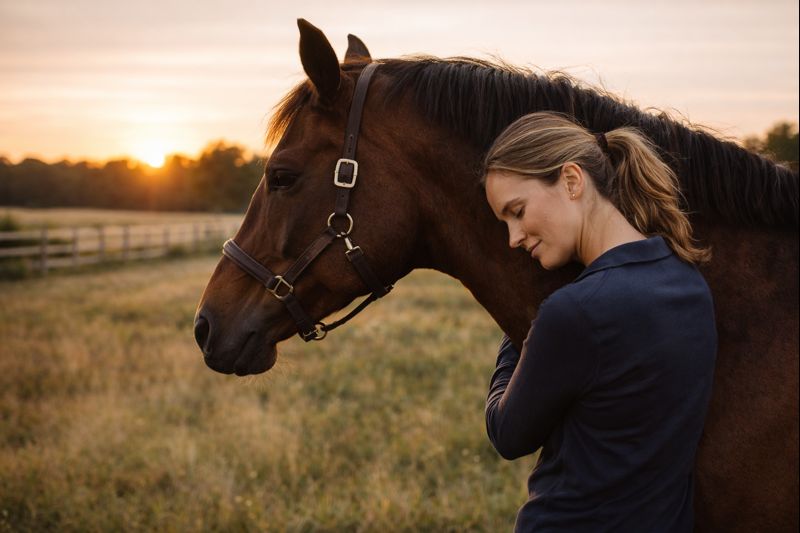
People often struggle to explain why time spent with horses feels different from other activities. It is not simply exercise, not just time outdoors, and not only a hobby. Many riders and horse owners describe the barn as a place where their mind quiets, their body relaxes, and their emotions feel more manageable—often without conscious effort or verbal processing.
This experience is not accidental, nor is it mystical. The therapeutic quality of time with horses emerges from the way horses interact with human nervous systems, routines, attention, and emotional states. Without offering advice or language, horses create conditions that support regulation, presence, and emotional clarity.
Horses Create Forced Presence
Modern life encourages constant mental distraction. People move through their day thinking about what happened earlier or what needs to happen next. Horses interrupt this pattern. They demand attention in the present moment.
A horse does not respond to multitasking. Grooming requires awareness of where your hands are. Leading requires attention to space and movement. Riding requires balance, timing, and feel. If your mind drifts, the horse responds immediately—by stopping, spooking, slowing, or becoming inattentive.
This forced presence acts as a mental reset. Attention shifts from internal rumination to external awareness. Over time, this repeated redirection trains the brain to stay grounded, reducing mental overload.
Non-Verbal Communication Reduces Cognitive Strain
Human interaction relies heavily on language. Words require interpretation, explanation, and emotional filtering. With horses, communication is primarily non-verbal. Pressure, release, posture, breathing, and intention replace conversation.
This simplicity reduces cognitive demand. There is no need to justify emotions or explain intentions. The horse responds to what is happening, not to how well it is described.
For many people, this absence of verbal processing creates relief. Emotional states are acknowledged through behavior rather than discussion. Calmness produces calm. Tension produces tension. The feedback is immediate and honest, without judgment.
Horses Regulate Nervous Systems Through Rhythm
Rhythm plays a significant role in emotional regulation. Walking, grooming, and riding all involve repetitive, predictable movements. These rhythms help calm the human nervous system in the same way slow breathing or gentle exercise does.
The motion of a horse at the walk, in particular, has a regulating effect. It is steady, symmetrical, and predictable. This rhythmic input helps reduce stress responses, lower heart rate, and create a sense of safety.
Unlike many forms of exercise that elevate stress hormones, time with horses often balances stimulation with regulation.
Emotional Feedback Without Judgment
Horses respond to emotional states without assigning meaning to them. Anxiety does not make someone weak. Sadness does not make someone difficult. Excitement does not need to be explained.
A horse simply reacts to the energy and clarity presented. This lack of judgment allows people to experience emotions without defending or suppressing them.
When someone approaches a horse feeling tense, the horse may become cautious. When that tension softens, the horse responds in kind. The feedback loop encourages self-awareness rather than self-criticism.
Physical Touch and Grounding
Physical contact plays an important role in emotional well-being. Grooming, braiding, and simple touch provide grounding sensory input. The warmth of the horse’s body, the texture of the coat, and the rhythm of brushing all anchor attention in the body.
Grounding sensations help regulate emotional states by shifting focus from abstract thought to physical experience. This is particularly powerful for individuals experiencing stress or emotional overload.
Unlike casual touch, interaction with horses requires intention and awareness, enhancing its regulating effect.
Routine as Emotional Stability
Barn routines provide structure without rigidity. Feeding, grooming, turnout, and riding follow predictable patterns that create a sense of order. This predictability supports emotional stability, especially for people whose daily lives feel chaotic or demanding.
Routine offers reassurance. Tasks are clear. Expectations are simple. Completion brings satisfaction without performance pressure.
Over time, these routines become anchors—familiar actions that signal safety and normalcy.
Horses Respond to Authenticity
Horses do not respond well to emotional masks. They react to what is real rather than what is presented. This quality encourages authenticity.
Trying to appear confident while feeling fearful often creates mixed signals. When a person acknowledges fear internally and softens their body, the horse responds more positively. This teaches an important emotional lesson: honesty creates clarity.
For many people, this is one of the first environments where they are not rewarded for hiding how they feel.
Responsibility Without Emotional Overload
Caring for a horse involves responsibility, but it is a grounded form of responsibility. The tasks are physical and immediate: water needs filling, hooves need picking, tack needs cleaning.
This type of responsibility differs from abstract stressors like deadlines or long-term uncertainty. It creates purpose without overwhelming the nervous system.
Focusing on the horse’s needs often reduces excessive self-focus, which can ease anxiety and emotional strain.
Learning Emotional Regulation Through Experience
Horses do not teach emotional regulation through explanation. They teach it through consequence. Tension leads to resistance. Calmness leads to cooperation.
Over time, people learn to regulate their breathing, posture, and reactions because it produces better outcomes. This learning happens experientially, not intellectually.
These skills often transfer outside the barn. Riders notice they pause more, react less impulsively, and recognize emotional shifts earlier.
Why the Effect Feels Therapeutic
The therapeutic quality of time with horses comes from several factors working together:
- Present-moment focus
- Non-verbal communication
- Rhythmic movement
- Physical grounding
- Predictable routines
- Honest emotional feedback
None of these elements require verbal processing or analysis. Together, they create an environment that supports emotional balance naturally.
Not a Replacement, but a Powerful Complement
Time with horses is not a replacement for professional mental health care when needed. However, it can be a powerful complement. The barn becomes a place where regulation is practiced rather than discussed.
For many, this is the first space where calm is experienced rather than pursued.
A Quiet Form of Emotional Support
Horses do not ask questions. They do not offer solutions. They do not interpret stories. They respond to presence.
In a world filled with noise, explanations, and constant evaluation, this quiet responsiveness feels deeply restorative. The therapy happens not because the horse tries to heal, but because the horse allows the human nervous system to return to balance.
Time with horses feels therapeutic because it strips interaction down to what matters most: awareness, rhythm, and honest connection—without a single word needing to be said.