
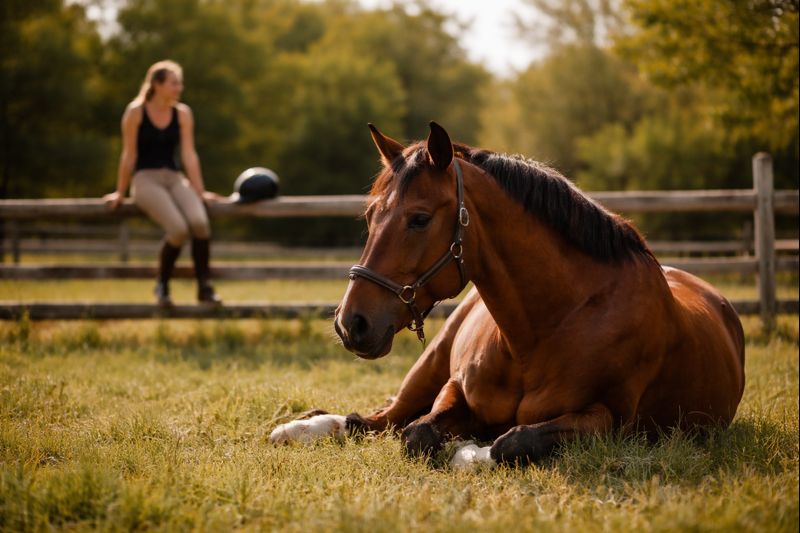
Recovery days are one of the simplest ideas in training—and one of the easiest to ignore. When riders feel motivated, have a competition coming up, or finally have access to good footing, it’s tempting to keep pushing. But the horse’s body doesn’t get stronger because you asked for “one more rep.” It gets stronger because it had time to adapt to what you asked yesterday. That adaptation happens during recovery.
A horse is not a machine that improves in a straight line. Training creates stress, the body responds to that stress, and progress appears only when the stress is followed by enough rest. Without recovery, you don’t get improvement—you get accumulation. Accumulated fatigue often looks like “attitude,” “laziness,” or “freshness,” when it’s really the horse’s system asking for a break.
Recovery Is Where Adaptation Happens
During work, muscle fibers experience microscopic damage. Tendons and ligaments take on load and respond by remodeling their structure over time. Bone density can increase with consistent, appropriate stress. But these changes don’t occur at the peak of effort; they occur afterward, when the body repairs and strengthens itself.
This is why recovery is not the opposite of training—it is a phase of training. If you remove recovery, you remove the phase where the horse becomes fitter, stronger, and more resilient.
Physical Recovery vs. Mental Recovery
Recovery is not only about muscles. Horses also need mental recovery. Schooling, especially in arenas, can be cognitively demanding: transitions, steering, balance, rhythm, responsiveness. When a horse is mentally tired, the signs can mimic physical fatigue: delayed reactions, loss of focus, tension, or dullness.
Mental fatigue is often created by:
– Repetition without variety
– Constant correction with little release
– Sessions that end only when the horse “gets it,” rather than when the horse stays confident
– High-pressure environments (busy arenas, frequent travel, unpredictable routines)
A mentally fresh horse is curious, willing, and able to learn. A mentally fatigued horse is surviving the session, not engaging in it.
What “Overtraining” Looks Like in Real Life
Overtraining rarely announces itself as a dramatic injury on day one. More often it arrives as subtle changes you might dismiss if you aren’t watching closely.
Common early indicators include:
– A longer, stiffer warm-up than usual
– Increased spookiness or irritability in familiar environments
– Resistance during tacking up (girthiness, pinned ears)
– More frequent stumbling or loss of rhythm
– Struggling to maintain the same level of work that was easy last week
– A horse that feels “not quite right,” even if no lameness is obvious
These are not character flaws. They are information.
What a Good Recovery Day Actually Includes
A useful recovery day should reduce strain while still supporting circulation, mobility, and calm movement. Unless your veterinarian has prescribed stall rest, “recovery” usually does not mean standing still.
Good recovery options include:
– Easy hacking on a long rein, focusing on relaxation
– Turnout that allows free movement and social contact (when safe and appropriate)
– Light groundwork: in-hand walking, gentle lateral yields, or stretching
– Pole walking at the walk for coordination without intensity
– A short hand-walk with grazing if your horse finds that calming
The key is to avoid heavy collection, intense jumping, prolonged fast work, or anything that creates significant muscular fatigue.
How Often Should Recovery Days Happen?
There isn’t one universal schedule. A young horse in early training needs frequent short sessions and regular easy days because their musculoskeletal system is still developing. An older horse may need more recovery due to slower tissue repair. A high-level performance horse may appear strong but still needs careful scheduling because the intensity of work is higher.
As a general principle:
– Increase recovery when intensity increases
– Increase recovery when the horse is learning something new
– Increase recovery after travel, shows, or stressful days
– Increase recovery during extreme weather or footing challenges
The “Easy Day” Is Not the Same as a Day Off
Some horses benefit from a complete day off, especially when turnout is plentiful. Others do better with an easy day of movement. The difference is important.
– **Day off:** no riding, minimal structured activity
– **Easy day:** light activity designed to relax and restore (often 20–40 minutes of low-intensity work)
Both can be valuable. The best program uses both depending on the horse’s needs.
Recovery Builds Soundness, Not Just Fitness
One of the most practical reasons to schedule recovery is injury prevention. Tendons and ligaments adapt slowly. If workload increases too quickly without recovery, these tissues are at risk of micro-damage that becomes a chronic problem. Many “mystery” soundness issues begin as overload, not as one dramatic event.
Recovery also supports hoof health and joint comfort. A horse that works hard on firm ground without enough easy days may develop soreness that changes movement patterns, leading to compensation elsewhere in the body.
How to Use Recovery Days to Improve Training
Recovery days can be strategically used to improve learning. If your horse had a breakthrough—better transitions, a calmer canter, improved acceptance of contact—give that nervous system time to consolidate. Many riders are surprised by how much better a horse feels after an easy day that follows a hard day. That’s consolidation in action.
A practical approach is to alternate:
– **Skill day:** focused training on a specific goal
– **Recovery or easy day:** relaxed movement to keep the body loose and the mind calm
– **Strength day:** conditioning or hill work (if appropriate)
– **Recovery day:** again, to allow adaptation
Listening to the Horse You Have Today
A smart schedule is only as good as your ability to adjust it. If you arrive at the barn and your horse feels unusually tight, distracted, or unwilling, a recovery day may be the best choice—even if your plan said otherwise.
A Simple Recovery Planning Framework
If you want a practical way to apply this, try a weekly “stress map.” Mark your horse’s week with three categories: hard, moderate, and easy. Hard days might include jump schools, intense conditioning, or demanding collected work. Moderate days could be flatwork with breaks, light poles, or short hill walks. Easy days are hacks, turnout-focused time, or gentle stretching sessions.
Then check your balance. If you have stacked hard days, insert an easy day between them. If you’ve traveled or shown, plan an easy day afterward even if the horse seems energetic. The point is not to do less—it’s to recover smarter.
In the end, the goal of training is not to do more. The goal is to do what creates improvement—and improvement requires recovery. A horse that is allowed to recover stays sounder, learns faster, and remains a willing partner for years, not just for a season.