
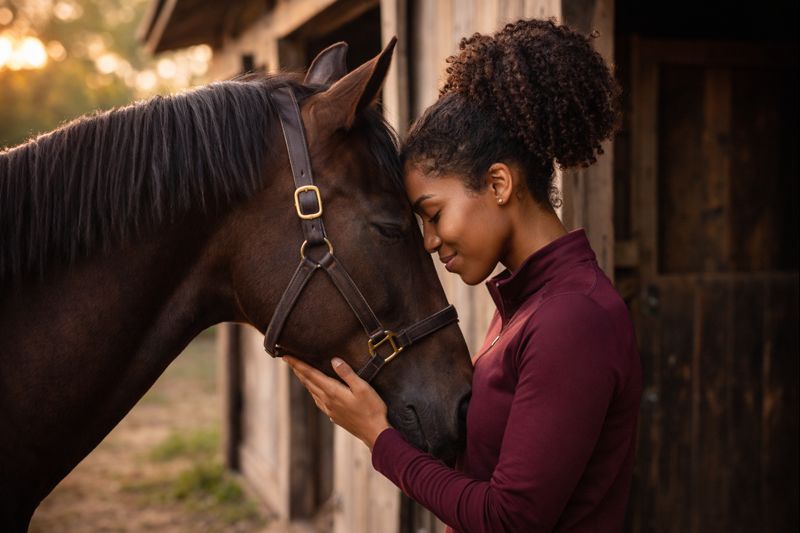
Emotional intelligence is often described as the ability to recognize, understand, and manage emotions—both our own and those of others. It includes self-awareness, empathy, emotional regulation, social skills, and the ability to navigate conflict thoughtfully. Most people develop emotional intelligence through life experience, therapy, education, or intentional practice. Horses offer something rarer: an immediate, non-judgmental feedback system that turns emotional intelligence into a practical skill you can’t fake.
The reason horses are such powerful emotional teachers begins with what they are. Horses are prey animals. Their world is built around safety, herd dynamics, and communication that is mostly non-verbal. A horse doesn’t ask, “What do you mean by that?” It reads the message in real time: your breath, posture, muscle tone, timing, and consistency. If your internal state and your external behavior don’t match, the horse notices. That makes horses uniquely effective at training self-awareness—the first pillar of emotional intelligence.
Self-awareness with horses is rarely theoretical. It becomes physical. Many riders discover they hold tension in their shoulders, clench their jaw, or brace their core when they feel anxious or pressured. They may not notice these patterns in daily life, but a horse often exposes them instantly. The horse might stiffen, drift, ignore the aids, rush, or become distracted. That feedback forces a question: What am I communicating without realizing it? Over time, riders become more skilled at detecting their own emotional shifts early, which is the foundation for managing them.
The second pillar is self-regulation. Horses teach that emotional control is not about suppression; it’s about choice. Training sessions inevitably include frustration—maybe the horse won’t load, won’t stand, or keeps breaking gait. Riders who escalate emotionally often escalate the horse as well. But riders who learn to pause, breathe, simplify the task, and release pressure at the right moment build trust. Horses reward calm clarity. That reward is powerful reinforcement for self-regulation, because it’s not abstract. You can see and feel the difference immediately.
Horses also develop empathy in a way that few activities do. Empathy is not pity. It’s the ability to understand another being’s experience. With horses, empathy begins with observation. Riders learn to read ears, eyes, nostrils, posture, and movement. They notice whether the horse is curious, tense, overwhelmed, tired, or uncomfortable. They learn that behavior is often communication. A horse that pins its ears during saddling may be expressing pain or irritation, not “attitude.” A horse that spooks repeatedly may be anxious or underprepared, not “bad.” This shift—from moral judgment to curiosity—is a hallmark of emotional intelligence.
As empathy grows, so does compassion. Compassion is empathy plus action. It’s not enough to notice that a horse is stressed; you adjust your approach. You warm up longer. You reduce intensity. You check tack fit. You address discomfort. You change your training plan. In human life, this becomes a transferable habit: noticing someone’s stress and responding with patience rather than criticism; recognizing tension in a conversation and slowing down instead of pushing harder.
Another often-overlooked aspect of emotional intelligence is frustration tolerance. Many people struggle with slow progress, repetition, and uncertainty. Horses teach patience because they learn at their own pace. They don’t care about your timeline. They care about clarity and safety. You can’t “hustle” a horse into trust. If you try, you often get resistance. So riders learn a different kind of progress: small, consistent steps. They learn to celebrate tiny improvements—a softer halt, a quieter transition, one calm step onto a trailer ramp. That patience builds resilience, a key component of emotional intelligence.
Horses also teach healthy leadership. Leadership with horses is not domination. It’s a combination of boundaries, clarity, and fairness. Emotionally intelligent leadership means you can be firm without being harsh, consistent without being rigid, and calm without being passive. Horses respond well to leaders who provide structure and safety. That involves emotional control: you correct behavior without anger, and you reward without overexcitement. You make decisions confidently, but you stay open to feedback. This is the same kind of leadership that benefits teams, families, and relationships.
Because horses communicate non-verbally, they improve social awareness too. Riders become more attuned to subtle signals: changes in breathing, shifts in posture, micro-expressions. That skill often translates to better human communication. People who spend time with horses often become better listeners. They pause more. They watch more. They speak less and observe more. In a world where everyone is rushing to respond, that quiet attentiveness is a social advantage.
Conflict management is another emotional intelligence skill developed through horses. Conflict happens when goals collide: the human wants the horse to go forward; the horse wants to stop. The emotionally unintelligent response is escalation—more force, more pressure, more frustration. The emotionally intelligent response is problem-solving: Why is the horse stopping? Is it confused? Afraid? In pain? Unfit? Distracted? Does it need clearer cues? Is the environment too challenging? This approach creates better outcomes with horses and with people. It replaces “winning” with understanding.
Horses can even help people heal emotionally. While they are not therapists by default, they create an environment where people practice trust, calm, and connection. Many riders describe the barn as a place where their nervous system settles. Part of that is the rhythm of care—grooming, walking, breathing. Part of it is the non-judgmental presence of the horse. Horses don’t care about your job title or your social status. They care about your consistency and safety. That simplicity can be deeply regulating.
Of course, emotional intelligence with horses also includes accountability. Horses teach that your actions have consequences. If you’re inconsistent, the horse becomes confused. If you’re rushed, the horse becomes tense. If you’re patient and fair, the horse becomes more willing. This builds a habit of reflecting on your impact, which is essential for emotional maturity.
The best part is that none of these lessons require perfection. Horses don’t demand that you never feel fear, frustration, or sadness. They invite you to notice those emotions, manage them, and keep communicating clearly. Over time, riders become more emotionally skilled not because they read about emotional intelligence, but because they practiced it repeatedly in a living relationship.
In a world that often rewards performance over presence, horses offer something different: they reward emotional clarity. And the emotional intelligence you develop with a horse doesn’t stay in the saddle. It follows you into conversations, relationships, and decisions—quietly improving the way you show up everywhere.