
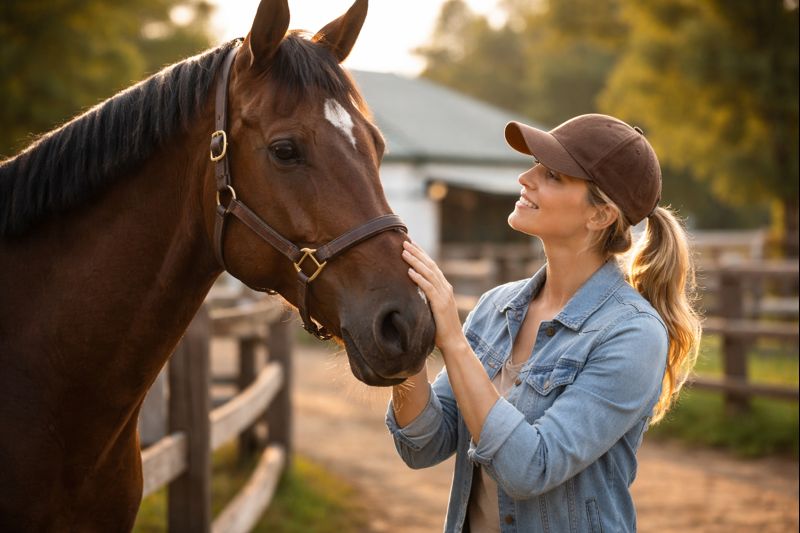
Horses have an uncanny way of teaching lessons that extend far beyond the barn. While most people come to horses for riding, sport, or companionship, many stay because of something deeper. Over time, horses begin to influence how people think, react, and move through the world.
These lessons aren’t delivered through words or instructions. They are learned through experience, repetition, and quiet moments of reflection. And once learned, they tend to follow people into everyday life — shaping relationships, work habits, and emotional resilience.
Patience Is Not Passive
One of the first lessons horses teach is patience — and not the passive kind. Working with horses requires active patience: waiting while staying engaged, calm while remaining attentive.
In daily life, impatience often leads to rushed decisions, miscommunication, and unnecessary conflict. Horses demonstrate that progress happens more reliably when people allow space for understanding to develop. Waiting for the right moment often produces better outcomes than pushing for immediate results.
This lesson translates directly to careers, relationships, and personal growth.
Consistency Builds Trust Faster Than Intensity
Horses do not respond well to unpredictability. They learn and relax when humans are consistent — emotionally, physically, and behaviorally.
In everyday life, consistency creates trust in the same way. Showing up reliably, communicating clearly, and responding calmly builds stronger relationships than dramatic effort applied sporadically.
Horses remind people that trust is earned through repeated, dependable actions rather than occasional bursts of enthusiasm.
Clear Communication Reduces Conflict
Horses are remarkably honest communicators. When signals are unclear, they don’t hide their confusion — they reflect it.
This mirrors human interactions more closely than many realize. Vague instructions, mixed messages, or emotional inconsistency often lead to misunderstanding and frustration.
Horses teach that clarity matters. Saying less, but saying it clearly, often leads to smoother cooperation — whether in the saddle, the workplace, or at home.
Emotional Regulation Is a Skill, Not a Trait
Horses don’t adapt well to emotional volatility. Anger, anxiety, or frustration disrupt communication and trust almost immediately.
To work effectively with horses, people must learn to regulate emotions rather than suppress them. This emotional discipline carries naturally into everyday situations, improving conflict resolution and stress management.
Life becomes easier when reactions are thoughtful rather than impulsive.
Presence Improves Outcomes
Horses require full attention. Multitasking has no place in meaningful horse interaction.
This demand for presence teaches a powerful life lesson: when attention is focused, quality improves. Conversations deepen, mistakes decrease, and connections strengthen.
Horses show that being fully present is often more impactful than doing more.
Respect Is Earned, Not Enforced
Horses respond to leadership rooted in respect, not dominance. Force may produce compliance, but it rarely produces trust.
This lesson translates clearly into leadership roles beyond the barn. Whether managing a team, parenting, or navigating partnerships, respect fosters cooperation far more effectively than control.
True authority comes from fairness, clarity, and consistency.
Progress Is Rarely Linear
Training horses reveals a truth many people struggle to accept: progress rarely follows a straight line.
Some days feel effortless. Others feel like setbacks. Horses normalize this reality and teach resilience in the face of uneven improvement.
Understanding that setbacks are part of growth reduces frustration and encourages persistence in personal and professional goals.
Listening Is More Than Hearing
Horses communicate constantly through posture, movement, and behavior. Learning to work with them requires learning to observe without interrupting.
In everyday life, this lesson encourages better listening — not just waiting for a turn to speak, but genuinely absorbing what is being communicated.
Stronger relationships grow from this kind of listening.
Boundaries Create Safety
Horses feel safest when boundaries are clear and fair. Inconsistent boundaries create anxiety and confusion.
This principle applies directly to human relationships. Clear boundaries protect emotional well-being, improve communication, and reduce resentment.
Horses teach that boundaries are not barriers — they are frameworks for healthy interaction.
Letting Go of Control Improves Connection
Horses remind humans that control is an illusion. The more tightly people grip outcomes, the more resistance they often encounter.
Letting go doesn’t mean giving up responsibility. It means allowing space for response, adaptation, and learning.
This mindset shift improves flexibility and reduces stress in everyday life.
Growth Happens Through Relationship
Perhaps the most profound lesson horses teach is that growth happens in relationship — not isolation.
Through partnership with horses, people confront their habits, emotions, and assumptions. Horses reflect what humans bring into the interaction with unfiltered honesty.
That reflection becomes a powerful catalyst for self-awareness and personal growth.
Final Thoughts
The lessons horses teach don’t stay confined to the arena or pasture. They quietly reshape how people approach challenges, relationships, and themselves.
Through patience, presence, clarity, and respect, horses model a way of moving through life that is calmer, more intentional, and more connected.
For those willing to listen, horses offer guidance not just on how to ride — but on how to live.